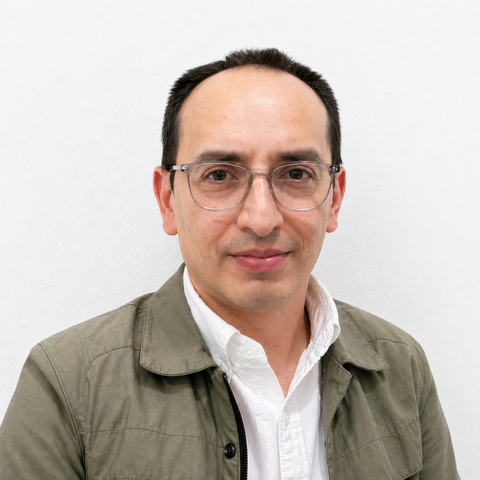
We interviewed Juan Carlos Reyes Vázquez, a fiction writer, screenwriter, and filmmaker from Mexico. Reyes is the author of five books of short fiction, including Impala (2021), Para subir y caer (2015), Iktumbe (2014), Circo de pulgas (2010), and Imagínate lejos (2002). His fiction often explores memory, loss, violence, childhood, altered bodies, and the fragile border between the intimate and the strange.
His work has appeared in the literary journals Crítica and Blanco Móvil, as well as in the anthologies Cuentistas de Tierra Adentro 2007–2017 and Cuerpos Rotos. He has also written and directed twelve short films, including Silla eléctrica para moscas, winner of Best Animated Short Film at the San Diego Latino Film Festival, and Absoluto vacío ensordecedor, winner of Best Experimental Short Film at the Dubai International Shortfilm Festival.
He holds a PhD in Creation and Cultural Theories and is a Senior Research Professor at Universidad de las Américas Puebla, where he has taught literature, film, narrative, and screenwriting for more than fifteen years. He is a member of Mexico’s National System of Researchers.
His participation is made possible by the support of Universidad de las Américas Puebla, University of Iowa International Programs, and generous donations made to the International Writing Program.
1. Do you have a plan or project in mind for your time at the residency?
My main plan during the residency is to continue working on a book of brief narratives that move somewhere between short fiction and fragments. The pieces draw on childhood, memory, domestic life, death, and the forms of violence that filter into everyday experience, but I am less interested in reconstructing the past than in shifting it slightly to see what still remains active in the present. Many of the texts also include subtle touches of the fantastic — not as a separate world, but as small disturbances within ordinary life. In Iowa, I would like to write new pieces, revise the ones I already have, and think more carefully about the overall structure and rhythm of the book. At the same time, I am also working on my second feature-length screenplay, which is already well advanced, so I hope to keep developing that project while I am there. Alongside these, I would also like to spend some time shaping an illustrated children’s book made up of very brief stories about animals. So although the book of fragments would be my main focus, I would like the residency to be a space where these different but connected writing projects can continue to grow.
2. How do you think the IWP Residency will benefit your writing craft, as well as your professional writing life?
I think the IWP Residency will benefit my writing craft by giving me time, distance, and a very specific kind of conversation with writers from different languages, traditions, and personal histories. For my current project, that exchange is especially important. I do not want the residency to be only an inspiring experience in a general sense; I hope it will translate into concrete formal decisions: changes in rhythm, structure, point of view, voice, and silence. Professionally, I also think the residency will expand the way I understand literary community. My work moves between fiction, screenwriting, film, and teaching, so I see writing not only as a solitary practice, but also as a shared inquiry. Being part of the IWP would allow me to place my work in a broader international conversation, while also bringing back new questions and perspectives to my own writing, my future projects, and my work as a teacher.
3. What are you currently reading right now? Are you reading for research or pleasure?
Right now, I am reading several things at the same time: El color del verano by Reinaldo Arenas, Lejos de mí decirles: Poesía reunida by Mario Montalbetti, and The Perception Machine by Joanna Zylinska. I usually read this way, moving between fiction, poetry, and essays, depending on what I need or what catches my attention. I am reading them both for pleasure and with my own work in mind. Arenas gives me a sense of freedom, excess, humor, and political imagination; Montalbetti makes me think about language, silence, and the strange precision of poetry; and Zylinska helps me reflect on perception, technology, and the ways images and machines shape how we understand the world. So, even when I read for pleasure, I am also paying attention to form, rhythm, and the way books think.
4. What is one thing the readers and writers of Iowa City should know about you and your work?
I deeply love what I do. I believe art saves us from life, while also giving life back to us in a more intense and mysterious way. That is probably why I have moved between different forms of storytelling: fiction, screenwriting, film, teaching, and research. For me, they are not separate territories, but different ways of asking similar questions. In my work, I am very interested in the absurd as an aesthetic, and also in the fantastic when it appears quietly inside ordinary life. I am drawn to small events, gestures, or accidents that suddenly escape what seems normal or controllable — moments when reality does not completely break, but becomes slightly strange. I also enjoy talking with people, listening to their stories, and discovering how others understand writing, images, memory, and the world.
5. Tell us about where you are from - what are a few favorite details you would like to share about your home?
I was born in Mexico City, then moved to Puebla, later lived in Monterrey while I was studying, and also spent a few months in Toronto. I currently live in Puebla and work in Cholula, where the university is located. So my idea of home has always been connected to movement between cities of different sizes and rhythms: very large cities, smaller but still intense cities, and places where urban life, history, and university life are constantly crossing each other. One thing I would like to share about Puebla and Cholula is that they are beautiful, but also complex. There are volcanoes in the background, old churches, markets, food, students, traffic, tourism, and ordinary daily life happening all at once. Like many cities, they are in constant tension between very beautiful spaces and more difficult, even terrible ones. I am interested in the way cities accumulate and manage those tensions: the social practices, meditations, inequalities, memories, and forms of coexistence that we cannot stop thinking about critically. That complexity has shaped the way I look at places, and probably also the atmosphere of much of my writing.